


10-minute read
Lessons of simplicity in IIoT analytics for Operations and Maintenance (O&M)
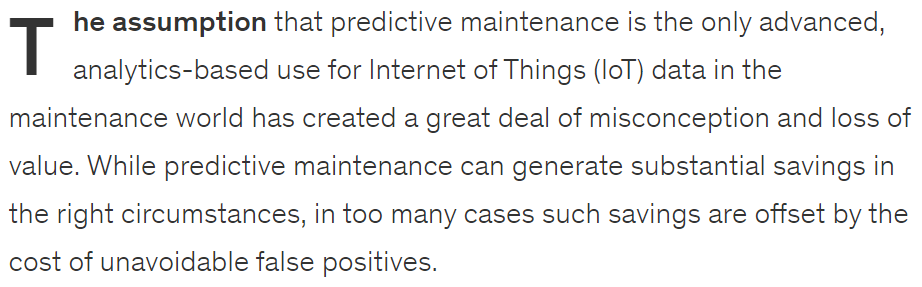
McKinsey’s July 2021 post Why many tech-driven maintenance programs are not working and what to do about it - Establishing the right analytics-based maintenance strategy echoes what we've been advocating for years as “fit for purpose and layered analytics” approach to IIoT data. The McKinsey post opens with:
One facet of a fit-for-purpose, layered approach to maintenance consists of “usage-based”, “condition-based”, “simple predictive”, “advanced predictive”… for more on this topic, see the links below for the posts, hands-on labs and workshops from the past few years:
Layered approach to maintenance/reliability (blog + hands-on workshop info + lab workbook).
But why stop at maintenance? In operations too, the same “keep it simple” and Occam's razor can save you from unnecessary complexity in your approach to IIoT analytics. For practical use cases with end-to-end walk-through, see:
Layered analytics (3-part series, recording and slides)
Emerson Automation's Jonas Berge in his Dec 2020 post opens with:
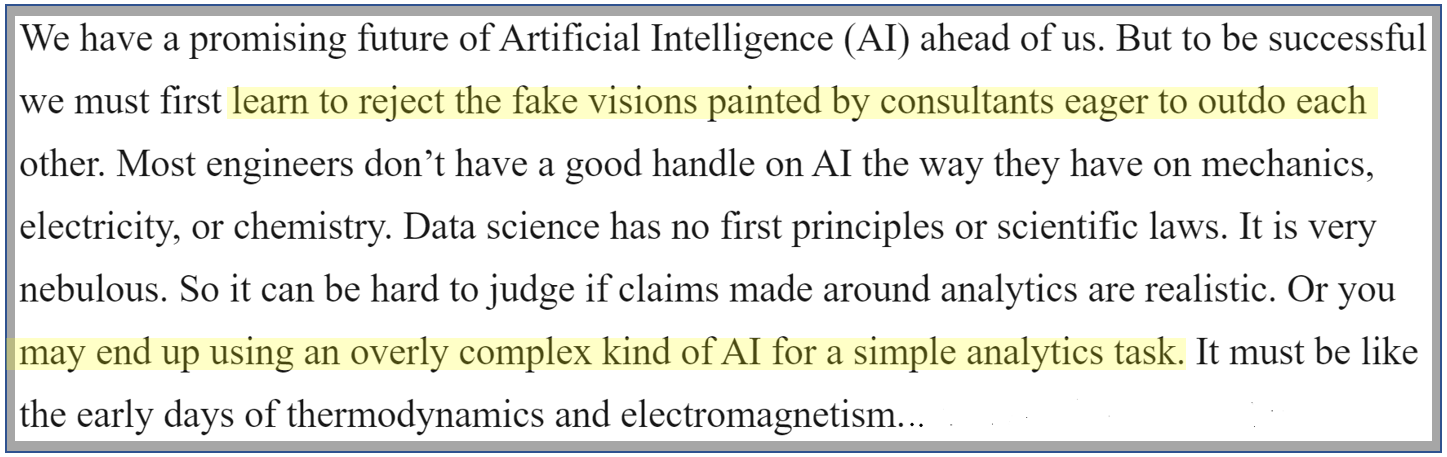
Yes, AI/ML (artificial intelligence & machine learning) has been gaining mindshare. Yes, AI/ML brings in a new set of capabilities. Yes... Yes... and, while it all seems promising when it works during the PoC (proof-of-concept), it can be frustrating when it stops working in a production deployment - either because you used a non-interpretable algorithm and/or the chosen model gives too many false positives/false negatives.
As such, a layered fit-for-purpose approach to analytics can be extremely valuable when you also leverage simple heuristics - extracted from SME (subject-matter-expert) knowledge - with basic math and Statistics 101. You can also include first-principles physics-based calculations that require only simple algebra and make predictions by extrapolating trends - backed by sound engineering assumptions.
Simple analytics as above is often called "engineered analytics" to differentiate it from AI/ML based analytics which includes "machine learning analytics" and "deep learning analytics."
For more on this, see:
EPRI Fleetwide Monitoring and Reliability Technology Event (July 2021)
Note that several AI/ML offerings in the market are cloud-only which brings its own wrinkle and a set of new challenges regarding cybersecurity and integration with plant-floor control and other on-premise systems. Also, the simpler engineered analytics is often done on streaming data at the edge without requiring a round-trip to the cloud.
The takeaway - start with proven fit-for-purpose analytics before chasing AI/ML PoCs with all its attendant risks, and the false positives/false negatives indicated in the McKinsey post. Form follows function; AI/ML yields to simple analytics. The simpler 'engineered analytics' captures the low-hanging wins and provides the foundation and the data-engineering required for the AI/ML layer. The oft-heard “… just give me all your data, let’s put it in a data lake and we will figure it out…” is naïveté.
The screen below (extracted from the EPRI talk) depicts what we see in successful customer deployments – 10000s of simple (engineered) analytics vs. 100s of AI/ML analytics. The 100 to 1 ratio is a useful guide and an easy metric to track. Even better is a 200 to 1 ratio. And better still is 500 to 1 or even higher. Such a quantified measure (ratio of engineered analytics to AI/ML analytics) makes it easy to recognize the complexity of your analytics deployment.

Remember Occam’s razor – fit-for-purpose analytics – no more complicated than necessary. Simple analytics when that will suffice and AI/ML only as necessary.
For an illustrative walk-through, come and attend the ECOLAB success story told by the customer at AVEVA PI World 2021 - Oct 19-21. In this work, the current ratio of the count of engineered analytics to AI/ML models is 400 to 0.
The upfront data engineering via 'engineered analytics' is largely in place and it now provides the foundation for business intelligence (BI) style slice & dice visual exploration (descriptive analytics), and for incorporating AI/ML models, i.e., advanced predictive analytics for use cases in predictive quality, predictive maintenance, and others.
Have you experienced or do you know of AI/ML initiatives that just did not live up to what was promised?
Your thoughts? We are listening  @FitForPurposeAn (FitForPurposeAnalytics)
Also see:
fit-for-purpose-layers-of-analytics-using-the-pi-system
A layered fit-for-purpose approach to IIoT analytics for process health via process control loops
11-rules-for-ai-success-if-youre-not-google
