


Configuration Management Overview
Effectively managing the infrastructure and configuration of PI System deployments, whether they are expansive or compact, can be a complex undertaking. The utilization of modern technologies is pivotal in mitigating risks, boosting productivity, ensuring consistency, and establishing auditable environments. Among the array of tools available, Ansible emerges as a robust solution, offering a seamless and automated approach to installations, upgrades, and configuration management of PI System components, ultimately optimizing operational efficiency.
Reducing Errors & Ensuring Consistency
In the realm of PI System deployments, the significance of consistency cannot be overstated. Ansible's automation capabilities play a pivotal role in reducing errors by consistently applying changes across every server in the deployment fleet. This not only guarantees a standardized configuration but also introduces repeatability and reliability into the deployment process. As a result, operational disruptions stemming from configuration discrepancies are effectively minimized.
Simplifying Management with Declarative JSON Definitions
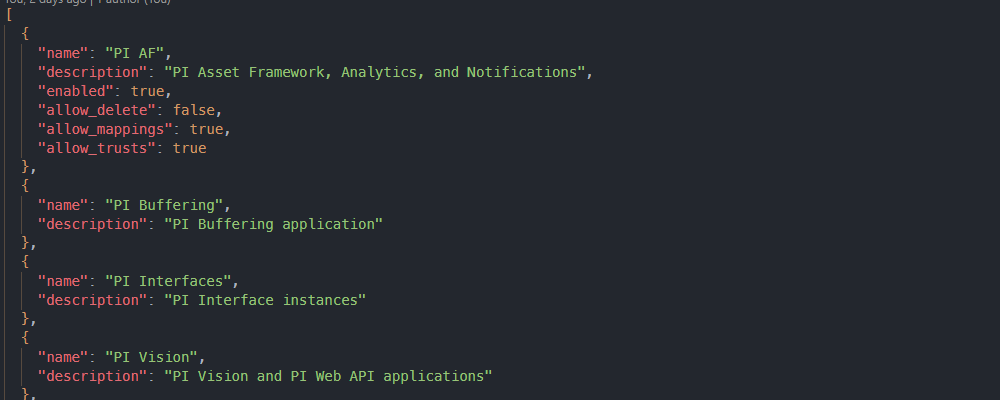
The use of declarative JSON definitions in Ansible simplifies the often intricate process of defining deployment configurations. This approach offers a clear and straightforward method for communicating deployment requirements in a universally understandable format.
As an illustration, let's delve into the simplicity of configuring identities for a PI Server/Collective through declarative JSON:
Version Control with Git for Configurations
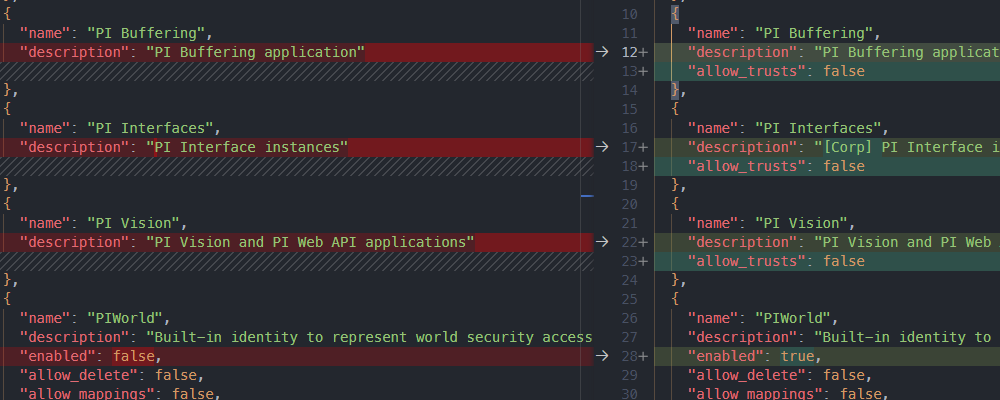
In the dynamic landscape of PI System configurations, version control is paramount. By integrating Git with Ansible, organizations gain a powerful tool to track changes, conduct comparisons between different versions, and even roll back configurations when needed (though it's essential to note that rollback is not universally supported for all PI products).
Explore the capabilities of Git in highlighting differences in deployment configuration for a system:
Approval Workflows for Controlled Deployments
Ensuring control and accountability in configuration changes is crucial for maintaining the integrity of a PI System deployment. Ansible and Git, when integrated into approval workflows, introduce an extra layer of control. Following best practices, Git facilitates collaboration among multiple developers, allowing them to work on a project simultaneously. A merge request process ensures that changes undergo thorough testing, review, and approvals before being deployed to the production environment, safeguarding the reliability and stability of the system.
Conclusion
The integration of Ansible for Configuration Management brings forth a plethora of benefits, encompassing enhanced reliability, efficiency, scalability, and security for industrial systems. By automating routine tasks, minimizing errors, and providing a streamlined approach to managing changes, Ansible becomes an indispensable tool for optimizing performance.
Visit our detailed blog post to explore more or inquire about implementing a solution in your environment: Harnessing the Power of Configuration Management with Ansible for AVEVA PI System | Mainely Innovations
What's next?
Stay tuned for our next post on leveraging Infrastructure as Code with Terraform for managing cloud infrastructure—servers, security, data storage, databases, and more—tailored for PI System deployments.
