


PI World 2021 stood out from previous PI World events in several ways, namely:
- It is the 2nd virtual PI World (no thanks to that cursed virus). This is good that for people that want to attend without dealing with people (i.e. me).
- It is the 1st PI World run by AVEVA. This PI World showcased how AVEVA's and OSIsoft's products can be used together.
- It is the 1st PI World that I "attended" 🙂
- Attendance is free
- High ratio of prizes to attendees
- Lots of games!
To celebrate the 1-month anniversary of PI World 2021, in this blog post, I will cover the strategies that you could have used to maximize your chances of earning a prize. Keep this in mind for the next PI World. 😉 You can still visit the PI World 2021 website and play the games.
Am I qualified to write this?
I registered for PI World 2021 "just to check it out" but then spent over 99% of the time on games (I'm 🦆ing serious). And then this happened:

I think that this makes me qualified to write this blog post. (Humblebrag much? 🙄)
Games of PI World 2021
For the sake of this blog post, a game is any method of earning a prize. There is only 1 type of prize: a PI Geek plushy and a Rocketbook Mini. There were 4 ways to earn a prize:
- Be part of the winning trivia team in 1 of the 3 time zones
- Get a perfect score (10/10) on the Scavenger Hunt quiz and have your name drawn (10 winners)
- Be a point leader under Gamification by completing actions and have your name drawn (up to 50 winners). In the end, this meant getting a perfect score (13,150/13,150) by completing all actions, and only 34 people qualified for the prize.
- Earn 1 of the top 3 scores in any of the following arcade games:
- Serpent (Snake)
- Alien Invaders (Space Invaders)
- Tetris
Obviously, I waited until after I received my prizes before revealing the tricks on how to increase your chances of getting a prize. All of the winners are listed here.
Trivia
I never learned how to join a trivia team, so I can't talk about this. thank u, next.
Gamification
This lightheartedly encouraged attendees to explore the PI World 2021 website. Below are all actions and their point value:
- Visit the "Attendee Directory" page (100)
- Visit an attendee's profile (1500)
- Watch a session (3000)
- Add a session to "My Schedule" (1000)
- Submit session feedback (2000)
- Visit the "Speakers" page (1750)
- Stop by the "Expo" lobby (100)
- Visit the exhibitors list (2400)
- "Favorite" a sponsor (600)
- Visit the "Brain Breaks" page (100)
- Take the "Scavenger Hunt Quiz" (200)
- Head to the "Photo Booth" (200)
- Visit the "Arcade" (200)
You had to be a "point leader" to be entered into the raffle, but since the point leaders earned full points (13,150), the points became meaningless and you had to complete all actions to be entered into the raffle.
Luckily, you could complete almost every action at any time during the event. From what I can tell, only "Watch a session" and 'Add a session to "My Schedule"' required you to pay attention to the time.
- For 'Add a session to "My Schedule"', you cannot add a session to "My Schedule" if the session is over, so this had to be completed before the last session started.
- For "Watch a session", you had to "watch" a session during its scheduled time (I think). Luckily, you did not have to watch the full session to earn these points; you just had to join it.
This was an easy chance to win that, unfortunately, not enough people took. There were only 34 winners out of a maximum of 50, partly because not enough people got full points, and partly because of 2 unmentioned additional criteria to be entered into the raffle:
- You cannot be an AVEVA employee
- You cannot have already won a prize in some other category
I actually got full points in Gamification, but the last criterion above disqualified me. 3 prizes would have been nice, though.
Scavenger Hunt
This 10-question multiple-choice quiz required you to watch some sessions to learn the answers. Unlike Gamification, a perfect score was an explicit requirement for entry into the Scavenger Hunt raffle. The dedication to attend sessions and the pressure to answer perfectly might have repelled some people. However, the sessions with the answers are pre-recorded and available on-demand, so you could take your time doing the Scavenger Hunt.
As they say, it doesn't hurt to try. I was initially intimidated by the questions, but it wasn't so bad once I started to fill out the quiz. I got a perfect score, was entered into the raffle, and had my name drawn.
Below are the questions and the choice of answers. The correct answers are bolded and underlined.
- What year was the first PI World conference held?
- 1985
- 1989
- 1990
- 1994
- In the keynote, Peter Herweck referred to an offering that would allow you to get industrial data from OSIsoft Cloud Services and AVEVA Connect together on a vendor neutral, industrial intelligence platform. What is the name of the platform?
- AVEVA Cloud Computing
- Edge to Edge Data Collection
- AVEVA Data Hub
- Data Collect Central
- During the keynote, Daniel Foster-Roman, the Engineering and Analytics manager from OPG (Ontario Power Generation) stated that with the use of the PI System and AVEVA monitoring and diagnostic center, they have achieved significant cost reductions from avoided costs on equipment failures. What is the total cost savings noted?
- $100,000
- $275,000
- $450,000
- $600,000
- As part of the keynote, Simon Combs, the Managing Director for Accenture Industry X, mentions that Accenture has been working with the PI System and AVEVA for how long?
- Two years
- Ten years
- Two decades
- Thirty years
- According to Rob McGreevy's profile, what is his favorite movie?
- Blues Brothers
- Top Gun
- Beetlejuice
- A League of their Own
- According to Ronan de Hooge's profile, what food would he choose to eat every day for the rest of his life?
- Mashed Potatoes
- Nachos
- Bread
- Skittles
- In the sponsor hall, how many sponsor booths are there?
- 8
- 10
- 12
- 14
- What is the name of the company mascot that makes many appearances on the Brain Breaks page?
- the PI Dude
- the PI Geek
- the PI Guy
- the Geek Man
- Who is AVEVA PI World's Platinum Sponsor?
- IBM
- INDEFF
- Accenture
- Skkynet
- How many puzzles are available to play on the Brain Breaks page?
- 8
- 10
- 12
- 14
Arcade games
Now begins the fun part of this blog post.
Arcade games overall
Some people might not have experienced the arcade because they would have seen this upon entering the arcade:
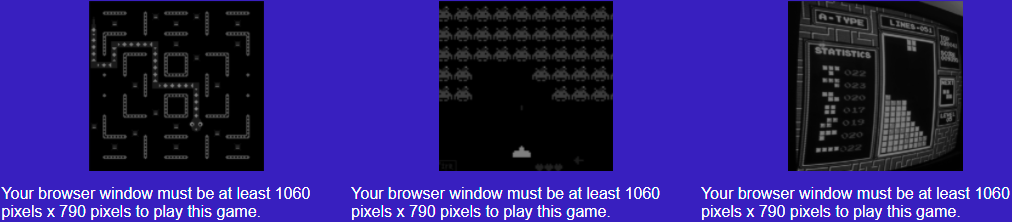
Zoom out in your browser until the message disappears. You can zoom back in after starting a game, but I recommend against it because you will probably exit 2 of the games a lot (see the "Glitches" sections below for more details). The games look fine even at 50% zoom, so I'm not sure why this minimum window size requirement exists. However, this restriction reduced the amount of competition that I encountered in the games. 😈
None of the games have an explicit pause feature. To pause the game, you must take the focus away from the game, which can mean switching browser tabs or switching windows. However, I don't recommend this for the games that speed up as you progress, since you will probably fail due to the additional time needed for you to remember where you left off.
All of the arcade games have an exploit that, thankfully, nobody abused (I think). When you enter any game, you are asked to enter your first name and last name as your user name, since your attempts are unfortunately not tied to your PI World account, since the arcade platform is not managed by AVEVA.

However, within PI World, you can change your first name and last name, meaning that you could change your name to that of a winner and cause confusion as to who the real winner is in an attempt to steal their prize. The workaround is to include your email address in your user name. Even if someone changes their name and email address to yours in PI World, the winner will still be contacted by email, and an impersonator will not have access to your email account.
Lastly, because the top 3 scorers in each arcade game get the same prize, the primary incentives to aim for 1st or 2nd place are bragging rights and peace of mind. If you place in 3rd, your score needs to be beaten only once before you lose your prize, whereas, if you place in 1st, your score needs to be beaten 3 times before you lose your prize.
Let's look at each arcade game in more detail.
Alien Invaders
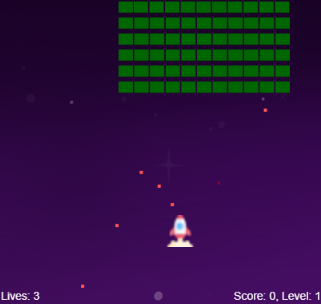
Expectation: 👾
Reality: 🟩
Description
An 11 × 6 rectangular swarm of aliens moves left and right across the screen, moving closer to you before it changes direction. Dodge the bombs that the aliens drop and shoot every alien to progress to the next level, which is identical to the previous, but everything is faster. Each alien takes only 1 hit to be defeated and seems to have the same chance of dropping a bomb relative to the game's speed. The game is over when you touch a bomb 3 times across your entire attempt or you touch an alien even once.
Controls
 ️
️ ️ to move
- Space to shoot
Scoring
How points can be earned:
- 5 points per alien killed
- (50 × level number) points at the end of each level
What does not impact the score:
- The time that it takes to finish a level
- Firing bullets or missing shots
- Touching a bomb (i.e. losing a life)
Glitches
- If you restart after losing without first exiting the game, the speed of your bullets firing will be reset but the speed of the aliens will not be reset, which guarantees a loss in some cases. To restart the game without carrying over any speed from previous attempts, you must exit and re-enter the game. Since you must re-enter your user name as well, it helps to keep your user name in the clipboard so that you can paste it instead of typing it.
- You cannot type a space in your user name because pressing Space counts as an input to the game. Space starts the game and is also used for firing, so you can actually lose the game before you finish entering your user name. To have a space in your user name, copy your user name from elsewhere and paste it.
Comments
Of the 3 arcade games, this one has the shortest play time, so you can retry it the most for the same amount of play time. However, in my opinion, this game is also the hardest. Even when you fire bullets continuously, you can afford to miss only ~½ of your shots before the aliens reach you, so you need to make your shots count. Also, you can get "RNG screwed" if the aliens will drop bombs in roughly the same spot at vertical intervals that are shorter than your ship, effectively creating a wall of bombs that you need to wait to pass before you can cross to the other side, which wastes precious time. Lastly, the later levels are very fast and it is very easy to get hit by bombs or, more likely, fail to shoot all of the aliens before they reach you.
Strategy
To have 1 less thing to pay attention to, hold down Space to fire continuously.
Staying near the middle gives you the greatest chance of shooting an alien, but since the middle of the swarm spends the most time near the middle of the screen, you will tend to wear down the middle of the swarm more than the edge. Instead, try to spend more time at the ⅓-way and ⅔-way points on the screen. You will inevitably move to the middle while dodging bombs and switching sides, so this should help wear down the swarm evenly. This "wear levelling" is important because it eliminates the closest layer of aliens the fastest, which buys you more time to eliminate them as they come closer. Try to be at the ⅓-way point that the swarm is heading towards so that they run into your bullets instead of you chasing the swarm.
Since each alien has the same chance of firing a bomb at any time, the bombs are the worst at the start and the level gets easier as you kill the aliens. (This is somewhat similar to radioactive decay.) At the start of the level, when the aliens and therefore bombs are abundant, focus on dodging bombs and trust that most of your continuous shots will hit an alien. As you kill the aliens and therefore reduce the number of bombs, you can afford to pay less attention to dodging and more on trying to hit the few remaining aliens.
Nerdy math
Since, at any point in the game, there is only ever 1 possibility for the number of points that you will earn next, the point system is just for show. Since clearing a level earns the player progressively more points, it reinforces to the player that they are playing progressively better. However, an alien kill count would have sufficed to track the player's progress. The player's score can be derived from the kill count and vice versa.
The player's score at any point in the game can be calculated as follows:
Levels beaten = current level − 1
Aliens per level = 11 × 6 = 66
We can combine the statements above to express the number of levels beaten in terms of the number of aliens killed so far:
Levels beaten = ⌊aliens killed so far ÷ 66 aliens per level⌋
Current score = total points for all aliens killed so far + total level-up points so far
Total points for all aliens killed so far
= 5 points/alien × aliens killed so far
= 5 points/alien × (66 aliens/level × levels beaten + aliens killed in the current level)
= 330 points/level × levels beaten + 5 points/alien × aliens killed in the current level
Total level-up points so far
= ∑(50 × i) for i = 1 to levels beaten
= 50 × ∑i for i = 1 to levels beaten
However, according to the triangular number formula, (∑i for i = 1 to n) = ½ × n × (n + 1), so we have:
= 50 × ½ × levels beaten × (levels beaten + 1)
= 25 × levels beaten × (levels beaten + 1)
If we want this to read more nicely, substitute levels beaten = current level − 1:
= 25 × levels beaten × (current level − 1 + 1)
= 25 × levels beaten × current level
Use the statements above to construct the version of the score formula that you find most useful.
Tetris

Description
A random tetromino ("block") falls from the top of the screen towards the bottom. Move and rotate this block before it lands at the bottom of the screen or on top of parts of previous blocks. After the current block lands, a new random tetromino will spawn at the top of the screen. When the blocks form a complete horizontal line across the screen, that line is cleared. As you progress, the level increases, so the blocks fall faster. The game is over when a newly spawned block overlaps with any part of a previous block.
Controls
- ️️ to move sideways
 ️ to rotate counterclockwise
 ️ to soft drop (undocumented) (soft drop = make the block fall faster)
- Space to hard drop (undocumented) (hard drop = drop the block to the bottom immediately)
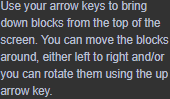
The screenshot below shows Tetris's instructions, which do not mention hard drops or soft drops:
Scoring
Below are the number of points awarded for clearing lines simultaneously:
- 100 points for clearing 1 line ("single")
- 400 points for clearing 2 lines simultaneously ("double")
- 700 points for clearing 3 lines simultaneously ("triple")
- 1200 points for clearing 4 lines simultaneously ("Tetris")
What does not seem to impact the score:
- Current level
- Levelling up
- Hard dropping
- Soft dropping
- Time
- Stack height upon clearing lines
- Clearing lines with consecutive blocks
I might be wrong about something above, since, if points were awarded based only on the number of lines cleared simultaneously, then the top players should have way fewer points when they reach Level 9. I also do not know what causes the level to increase. The level counter can increase while a block was falling, so maybe it is based on total fall distance. I'm not good enough at Tetris to be able to play well in the later levels and still look at my score, and I'm not dedicated enough to answering these questions to record my screen or look at the JavaScript code. I also do not know how many points are awarded, if any, for clearing the entire field.
Glitches
If you restart after losing without first exiting the game, the speed of the falling blocks will not reset from your previous attempt. To restart the game without carrying over any speed from previous attempts, you must exit and re-enter the game. Since you must re-enter your user name as well, it helps to keep your user name in the clipboard so that you can paste it instead of typing it.
Comments
The version of Tetris used for PI World 2021 differs from "classic" versions of Tetris in several ways, which make the former harder:
- You cannot see your next block
- You cannot rotate your block clockwise
- You cannot "hold" a block for later
- No counter of lines cleared
- T-Spins are not possible because T blocks do not rotate about their "middle" piece when they go from ┫ to ┳ (dat use of Unicode, tho)
- The colour and shape of a block are mutually independent
Strategy
- Level 10 is too fast for anyone to handle with the game's current controls, so avoiding the risky "Tetris" setups and playing for longer is not an option to get a high score. You must try to get as many points as you can before Level 10, which means clearing as many lines as you can simultaneously as much as you can.
- Prioritize accommodating the different shapes.
- Put the hole that is intended for the straight blocks at the edge of the screen. This maximizes the number of possible places to put other blocks without blocking the hole.
- Keep the surface of your block stack as flat as you can. Tall peaks restrict the number of possible places where you can put blocks without creating overhang.
- Don't be afraid to plug a hole if it means having greater control over your block stack. Remember: you won't actually plug a hole if the plug immediately clears.
- You don't get points for hard/soft dropping, so take your time.
- At Level 8, stop setting up for "Tetrises" and focus on surviving, since the game's controls are not suited for the high speeds of the higher levels.
Serpent
Description
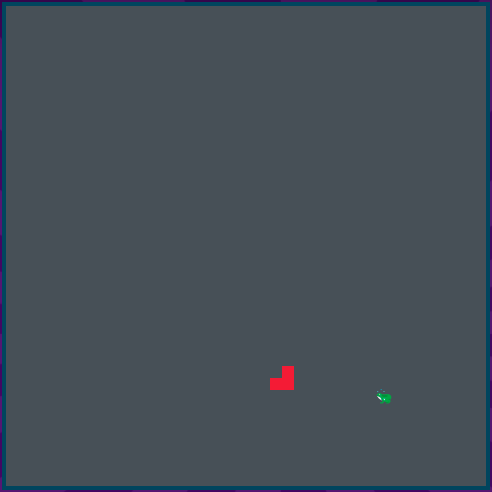
You begin as a snake that is 3 squares long. Move around the grid and eat the single stationary frog. When you eat a frog, the snake lengthens by 1 square and a new frog appears at a random place on the grid. The game is over if you run into yourself or the edge of the screen.
Controls
️️️️ to move the snake
Scoring
5 points per frog eaten
Mistakes
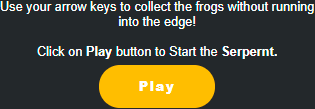
After you enter your user name but before you start the game, it says "Click on Play button to Start the Serpernt." above the Play button. "Serpent" is misspelled and the wording is awkward. However, AVEVA did not develop the game.
Comments
Unlike most versions of Snake, frogs can appear on a square that is occupied by the snake's body. Each time this occurs, you must move the snake out of the way before you eat the frog. This increases the average time to eat a frog compared to versions that forbid this overlap.
Of the 3 arcade games, it is easiest to get a high score in Serpent, partly because it is the least affected by the random number generator. However, each attempt also takes the longest. Serpent is more of a game of patience than of skill.
Strategy
In any version of Snake, the key to survival is to keep your body out of your way to ensure that you don't accidentally trap yourself in an area closed off by the snake's body and/or the edge of the screen. Getting yourself out of your way should always take priority over the distance travelled or time taken to eat the frog. Early in the game, when the snake is short, you can largely afford to go straight to the frog. As the snake grows, you might need to move in a giant circle to get yourself out of your way before going to the frog.
However, when the snake gets very long, you will need to move in a method similar to streak plating in microbiology or to the alien swarm in Alien Invaders. That is, move close to but not exactly at one of the corners. Bunch yourself up into a rectangle with no empty space inside by making tight zigzags that span most of but not all of the length of the grid, slowly moving towards the middle of the grid. Once your body is bunched up and out of your way, reach out perpendicular to your "streak" and eat the frog. Pick a different side of the grid to streak along and repeat the process. This is very slow but there is little alternative if you want the high scores.
The version of Snake used in PI World 2021 has other things to keep in mind. You must be careful to not press a key while another key is still held down, otherwise the movement from that last key press might not execute. Unlike the other 2 arcade games, which speed up as you progress, Serpent slows down due to lag. This makes the game take much longer than it already is, but you can also use the lag to your advantage to input your movements more precisely. After ~400 points (80 frogs eaten), the lag becomes noticeable, and after ~1000 points (200 frogs eaten), the snake moves at <2 squares per second. This is slow enough that I could afford to take screenshots while playing. The lag might also cause your inputs to be delayed or dropped, so it helps to mash the arrow key to ensure that the movement is executed. The last twist in Serpent is that you must press the arrow key 2 frames before you expect it to be executed.
Nerdy math
We will calculate the maximum possible score and the time that it takes to achieve it.
Abbreviations:
🟥 = snake square(s) (area)
🐸 = frog(s) eaten
At 80% zoom (my screen is too small for 100% zoom), the side length of the grid is 480 pixels and a unit of the snake is 12 pixels long. Both are square.
At 100% zoom, these would be:
Grid length = 480 pixels ÷ 80% = 600 pixels
Snake square length = 12 pixels ÷ 80% = 15 pixels
Next, we want to know how many snake squares fit in the grid:
Grid length = 600 pixels ÷ 15 pixels/square = 40 squares
Grid area = (grid length)² = (40 squares)² = 1600 🟥
To determine the maximum growth of the snake and therefore also the maximum number of frogs that can be eaten (since the snake grows by 1 square for every 1 frog eaten), we must subtract the snake's initial area:
Initial area = 3 🟥
Maximum growth = grid area − initial area = 1600 🟥 − 3 🟥 = 1597 🟥
Maximum 🐸 = maximum growth × growth per 🟥 = 1597 🟥 × 1 🐸/🟥 = 1597 🐸
Now, we can calculate the maximum possible score:
Points per 🐸 = 5 points/🐸
Maximum possible score = maximum 🐸 × points per 🐸 = 1597 🐸 × 5 points/🐸 = 7985 points
We're not done yet! The winning score of 1735 took about 2.5 hours to achieve. From this, we can estimate the time that it takes to achieve the maximum possible score:
🐸 = points ÷ points per 🐸 = 1735 ÷ 5 points/🐸 = 347 🐸 (this conversion is not necessary but makes the math easier to visualize)
Time per 🐸 = 2.5 hours ÷ 347 🐸 ≈ 26 seconds/🐸
Time to achieve the maximum possible score = time per 🐸 × maximum 🐸 = (2.5 ÷ 347) hours/🐸 × 1597 🐸 ≈ 11.5 hours
The result of 11.5 hours to achieve the maximum possible score assumes that the average speed of the game (🟥 moved per time) is the same as that during the winning playthrough. However, the actual time to achieve the maximum possible score will likely be higher due to the game lagging even more as the snake grows and the additional time needed to get the snake's body out of the way before trying to grab the frog.
For fun, let's finish by calculating the winning run as a fraction of the best possible run:
Winning run's progress to a perfect score = 🐸 from the winning run ÷ 🐸 from the best possible run = 347 🐸 ÷ 1597 🐸 ≈ 21.7%
Winning run's progress to completely covering the grid = (347 🟥 + 3 🟥) ÷ 1600 🟥 = 350 ÷ 1600 = 7 ÷ 32 ≈ 21.9%
Screenshots
Here is a screenshot of the 4th-place run (1110 points) moments before death:

Here is a screenshot of the 1st-place run (1735 points) moments before death:

That's not blood dripping from the ceiling. That's the snake.
In both runs, I inputted my movement too late (only 1 frame before I expected it to be executed), so I crashed into the edge of the grid and lost. This is why I don't have my driver's license.
At one point, my 4th-place run was the 1st-place run, but since the next best scores were not too far behind, I knew that my score could be easily beaten, so I played what ended up being the winning run and bumped my previous high score down to 2nd place. My prediction was right, and the next day, Lucas Beristayn and Christopher McAulay beat my previous high score, bumping it down to 4th place. Even though there was still plenty of time for them to beat the scores above theirs, it wasn't worth it. It takes at least 1.5 hours of continuous play to get those scores, your hand hurts after playing for that long, and you must start over if you make the slightest mistake. I had many close calls in the winning run. The top 8 scores belonged to only the 3 of us, so it was safe to assume that we would remain the top 3 and get a prize, which we did. Good game, guys!
Integration of PI World games with PI
For the next PI World, I would like to see better integration between the games and PI. Ricky Sun gave us a taste of gaming with PI Vision in his blog post "Game in PI Vision with the PI System", but with the right choice of game, you can plot an entire run in PI Vision, record players' inputs to replay their runs, and even compare and play back runs multiple runs simultaneously between the same player and/or different players (see my comment on that blog post for more details).
In a nutshell, for a run to be plottable in a PI Vision trend, the game should be a 2D "don't hit the wall/floor/ceiling" rail game where you move at a constant speed in 1 direction (preferably right) and have free movement only in the directions perpendicular to it (preferably up and down). Some examples of games that meet these criteria are:
- Flappy Bird and its clones
- The Impossible Game and its clones (e.g. Geometry Dash)
- Helicopter Game, but without floating obstacles
- Nyan Cat?
Does anyone at AVEVA think that this would be worth it?
Conclusion
I hope that you had as much fun at PI World 2021 as I did. While it is too late to earn a prize, you can still use the strategies for the arcade games and try to get a high score. Go out there and show 'em what you're made of! If you liked this blog post, consider checking out my other blog posts here.
See you at the next PI World (if it is virtual 😜)!

